
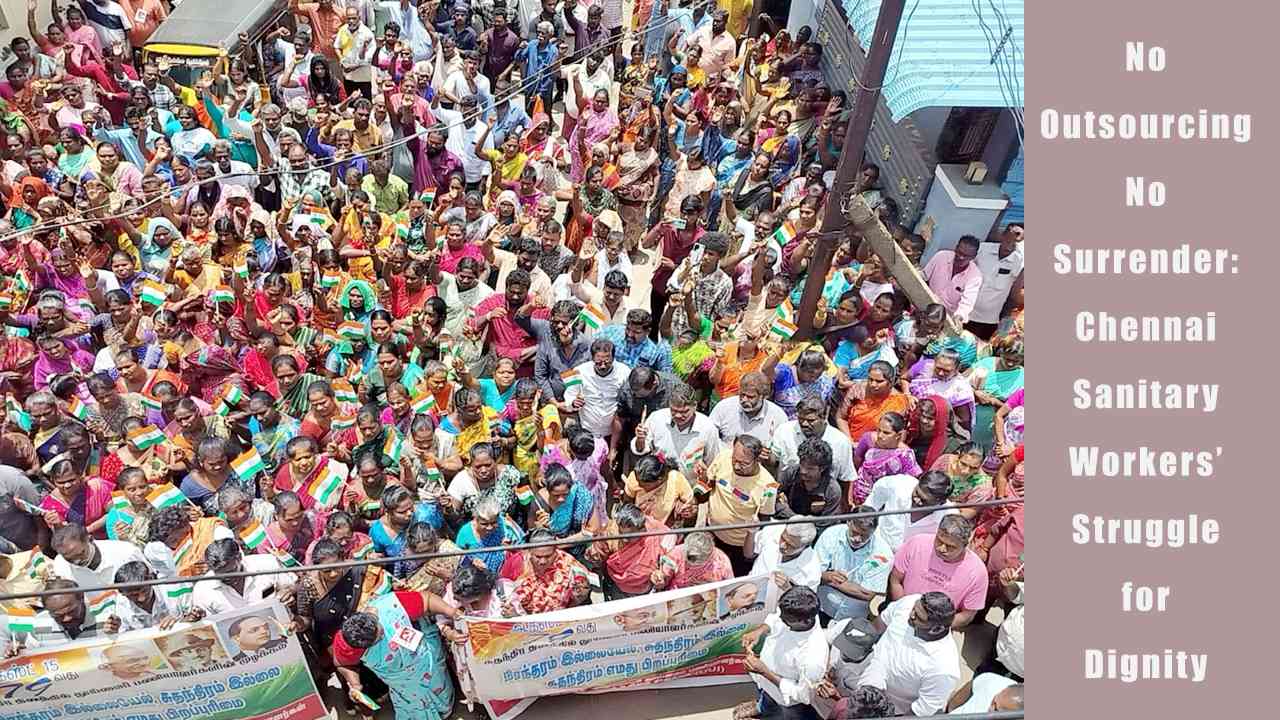
On 2nd September, the All India Central Council of Trade Unions (AICCTU) and affiliated organisations held a state-wide protest in Tamil Nadu. They condemned the police for filing false cases against leaders of AICCTU and LTUC, and demanded statutory minimum wages for all sanitary workers in the state as per Government Order 62. This protest came in the backdrop of the historic struggle of Chennai’s sanitary workers, which has brought their working and living conditions to the centre of Tamil Nadu’s political discourse.
Sanitary workers of Zones 5 and 6 of the Greater Chennai Corporation (GCC), employed directly under the NULM scheme, opposed the outsourcing of waste management. In April 2025, GCC passed a resolution to outsource waste management for a contract of Rs. 273 crore per month.
For the workers—who have put in 5 to 20 years of service—outsourcing meant loss of job security and wage cuts. They would cease to be NULM beneficiaries from 01.08.2025, and their monthly salary would drop from about Rs. 23,000 to Rs. 15,000. In the other 11 outsourced zones, they had already seen how insecure contractor-based employment could be. For these workers—largely from oppressed castes, and 80% women, many of them single mothers—the government’s claims of social justice rang hollow.
Statutory minimum wages had been won only after years of struggle under the Workers’ Rights Forum (WRF), with daily wages gradually increasing from Rs. 410 to Rs. 753. The workers were not ready to accept a wage cut that would only benefit corporate contractors.
Throughout June 2025, sanitary workers of Zones 5 and 6 campaigned for permanency of employment and against outsourcing. Over a thousand workers joined, raising Rs. 7 lakh and reaching lakhs of residents to mobilise support. A legal battle for regularisation also ran parallel to the campaign.
On 1st July, led by Com. Bharathi, President of AICCTU (TN) and WRF, the workers gheraoed GCC headquarters at Ripon Buildings. They were arrested and released later that evening but refused to disperse until GCC assured talks with the Commissioner. A demonstration followed on 4th July at the Collector’s office. On 9th July, when contractor vehicles appeared in zonal offices, workers staged a road roko. Police detained over a thousand workers, but they again refused to leave until promises of dialogue were given.
On 25th July, five women workers began an indefinite hunger strike at the LTUC office. Political parties including CPI, CPI(M), VCK, DMDK, SDPI, and several central trade unions visited and expressed solidarity. After six days, the government issued a GO (30.07.2025) deferring outsourcing until the court decided on the issue, and the hunger strike was withdrawn.
But on 31st July, GCC abruptly informed workers that their NULM jobs had ended and they would have to join the contractor Enviro Solutions from 1st August. Forced to protect their livelihood, they launched a sit-in protest outside Ripon Buildings.
From 1st August, more than 2,000 sanitary workers sat in at GCC headquarters, demanding their jobs back. The protest gained massive traction on social media and in mainstream media, drawing solidarity from political parties, students, celebrities, advocates, and trade unions. Filmmaker Pa. Ranjith’s Neelam Social covered the protest daily and later released a documentary.
Garbage piled up in the two zones, sparking health concerns among residents. Meanwhile, solidarity protests were held in Chennai and across Tamil Nadu. CPI(M) State Secretary Com. Shanmugam and VCK President Com. Thirumavalavan even met the Chief Minister to press for a solution.
Seven rounds of talks were held, but the government insisted privatisation was policy, while workers stood firm with one demand: No outsourcing. Notices for unlawful assembly were served to leaders like Com. Bharathi, Janakiraman, Suresh, Mohan, and Jothi. With Independence Day nearing, workers waved the Tricolour and declared: “No permanency means no independence.”
On 13th August, the Madras High Court permitted police to evict protestors, citing inconvenience to the public. That night, hundreds of police personnel surrounded Ripon Buildings. Roads were blocked, and by midnight, the police began eviction. Women workers were dragged and thrown into vans, and leaders were forcefully arrested. Protestors were dispersed into eight remote detention sites. Many were injured or fainted, and some were unaccounted for.
Over a thousand workers and leaders were released only the next afternoon after a habeas corpus petition was filed in the High Court. Advocates and trade unions held solidarity demonstrations demanding their release.
On 15th August, workers regrouped at the LTUC office, observed Independence Day, and resolved to continue their struggle. The High Court allowed outsourcing but directed GCC to ensure wages were not reduced, further strengthening workers’ resolve. The same day, GCC announced that outsourcing in Zones 4 and 8 would be shelved, fearing unrest before the 2026 Assembly elections. Workers hailed this as a partial victory.
At the same time, false cases were filed against union leaders, and the court barred Comrades Bharathi and Suresh from speaking or writing on sanitary workers. A commission may probe the police excesses of 14th August.
WRF petitioned for permission to continue protests at a designated site like Rajarathinam Stadium, but the police opposed it, arguing workers should appeal legally instead. On 29th August, more than 1,300 workers submitted memoranda at their zonal offices demanding their NULM jobs back.
The workers have resolved to carry forward their struggle until their rights, fair wages, and dignity are secured.