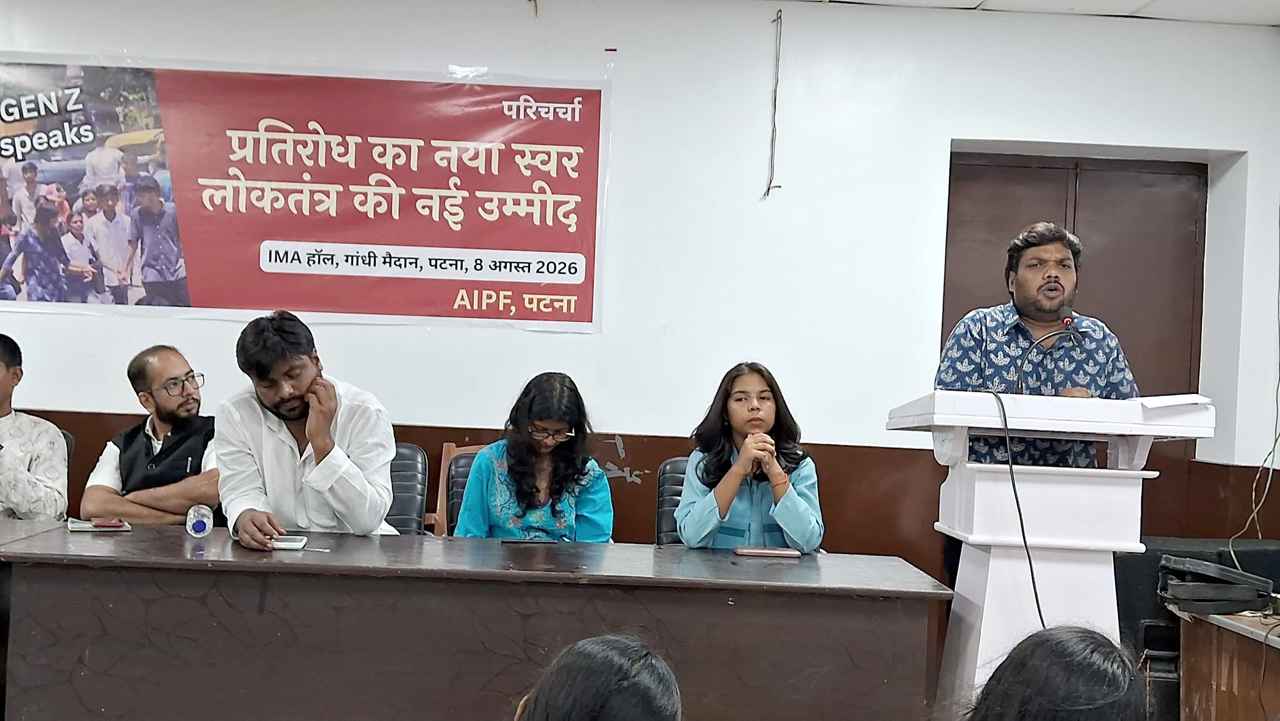

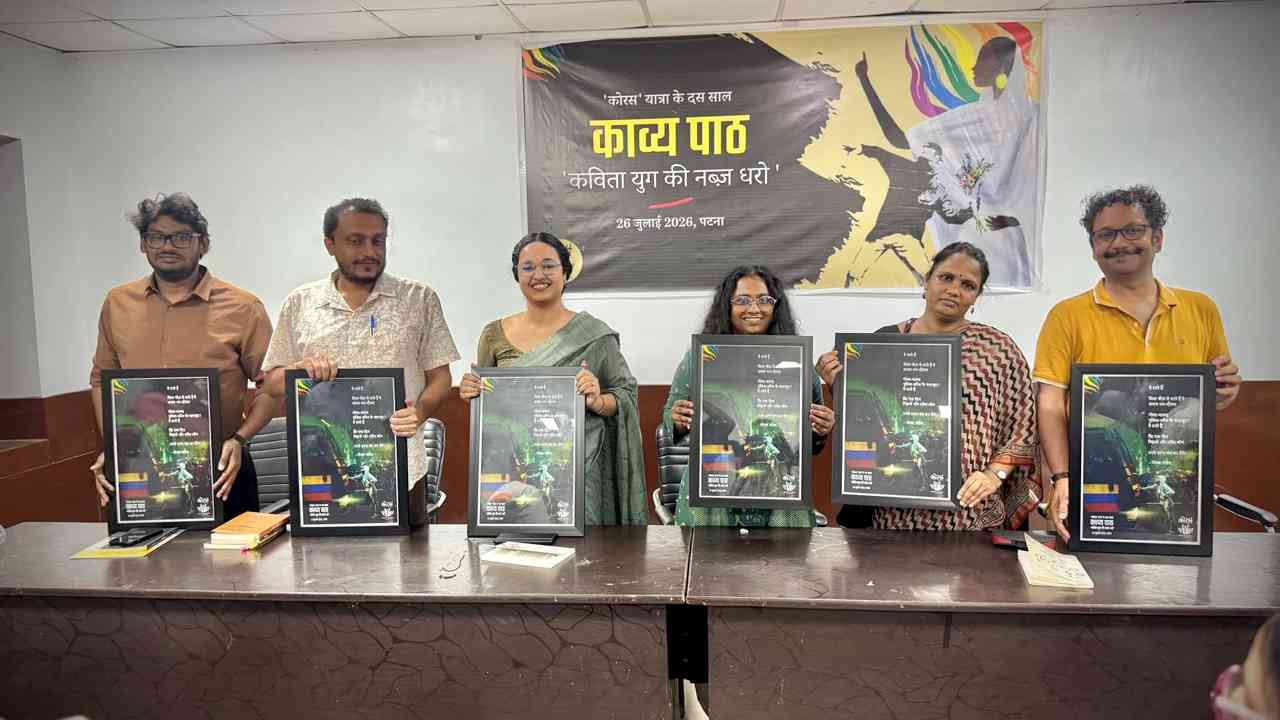
Marking ten years of its journey, Chorus organised a major poetry gathering in Patna on July 26 under the title “Hold the Pulse of the Age” (Kavita Yug Ki Nabz Dharo). Held at the IMA Hall, Gandhi Maidan, the event brought together young poets from different parts of the country whose work gives voice to marginalised communities and articulates resistance to authoritarianism, patriarchy, violence and the destruction of human and ecological life.
The poetry gathering could be seen as an assertion of a young, resistant cultural voice against an increasingly repressive culture. At a time when authoritarian forces across the world are attempting to impose their rule through violence, bombs, lathi charges and other instruments of coercion, the poets gathered in Patna sought to counter the politics of hatred with imagination, solidarity and the language of resistance.
The response from Patna was striking. The auditorium was packed with listeners who had come from across the city; all seats were occupied and even standing space became scarce. The overwhelming participation reflected Patna’s enduring tradition of democratic dissent and its faith in the need to record fearless voices, share the pain of hunger and violence, and defend the dream of a liberated and humane society.
The programme opened with the poetry of Adnan Kafeel Darvesh, recipient of the Bharat Bhushan Agarwal Award. He recited poems including These Are Gulmohar Flowers, These Children, The Cup of Damnation, Good Poetry, Zikr-e-Mir and My Children. His poetry confronts the darkness of fascism with the possibility of light and transformation. The aspirations of children who dream of fundamentally changing society are central to his poetic imagination.
Anupam, from Delhi, followed with poems including I Must Give Birth to This Child, Language, The Poem and the Dark-skinned Laughing Woman, The Colour of Poetry, A Solitary Journey and Even Darkness Has an Order. Her poetry interrogates the social structures that treat women as naturally subordinate and examines the patriarchal norms imposed on women’s bodies, minds and desires. Her work offers a critique of civilisation itself and imagines a society in which women and men, the earth, politics and love become equal participants in shaping a new world. For Anupam, women’s freedom to create themselves as human beings also demands a transformation of the social structures that shape men.
Young poet Shivangi Goyal, who came from Allahabad, recited For the Life Partner, The Honour of Girls, On the Murder of My Maternal Uncle and Unwanted Marks. Her poetry does not conceal tenderness, desire, wounds or scars. Instead, it brings them into the open and expresses anger with equal intensity and uncompromising force.
Vihag Vaibhav, another recipient of the Bharat Bhushan Agarwal Award, read Those Who Wish to Return from This Turning Point May Return, A Dialogue with Civilisation, Which River Was It Whose Waters Carried No Shadows of Stones?, Excavation and They Wanted Something Very Ordinary. Vihag has recently returned from a prestigious translation workshop held at a university in Denmark. His poetry connects struggles over identity with the larger struggle to transform the world. He writes against attempts to manufacture false forms of resistance and insists that in a dangerous fascist order there can be no space for cosmetic or counterfeit opposition.
Poet Rupam Mishra recited Some People Come, How Many Battles for Rights and Justice, I Want to Fight Your Battle, In That One Hoarse Voice and Lal Mohammad Jogi. Her poems draw deeply from the realities of rural life and register the silent resistance of women living under an oppressive patriarchal order. At the same time, her poetry foregrounds the power of love to challenge the hatred of the present moment. The image of a mother dreaming of a beautiful world and drawing strength from her children becomes an important source of hope in her work.
The session was chaired by poet and critic Mrityunjay, who underlined the urgency of bringing together all oppressed identities and voices of resistance in the present dangerous times. Only through such unity, he said, can a common path forward be created—and it is precisely this path that the new generation of poets is preparing. He also recited his poems Chemotherapy and Gaza.
Poetry and music remained closely intertwined throughout the programme. Chorus comrades opened the event and accompanied the poetry readings with musical performances. Poems by Suryakant Tripathi ‘Nirala’—Gahan Hai Yah Andhkara—Raghuvir Sahay’s Padhiye Sita, and Viren Dangwal’s Hamara Samaj were presented in musical form. Samta Rai, Runjhun, Riya and Rita performed the songs, with Jyoti accompanying them on guitar.
The programme was conducted by Chorus member Runjhun, whose literary and lyrical style gave the event a distinctive rhythm. In her vote of thanks, Chorus National Secretary Samta Rai expressed gratitude to all the poets, listeners and members of the organising committee who made the gathering possible.
The event was attended by prominent poets, writers, critics, cultural activists and intellectuals, including Alok Dhanwa, Madan Kashyap, critic Ramji Rai, critic Siyaram Sharma, Jan Sanskriti Manch National General Secretary Manoj Singh, critic Pranay Krishna, social scientist Vidyarthi Vikas, poet Kaushal Kishore, Sanjay Joshi of Pratirodh Ka Cinema, poet Ranjit Verma, poet and lyricist Sanjay Kumar Kundan, poet Kumar Mukul, writer Santosh Dixit, writer Sushil, social activist Madhubala, Sushmita, senior theatre personality Zahoor Alam, Rajkumar Soni from Chhattisgarh, Prabhat Khabar feature editor Ajay Kumar, Jitendra Kumar from Ara, writer Shahanshah Alam, poet Rajesh Kamal, writer Prabhat Parineet, poet Ramesh Ritamabhar from Muzaffarpur and young poet Tanuj from Banaras, among others.
Poets Arvind Paswan, Nikhil Anand Giri, Krishna Sammiddh, Prabhat Jha, Shovan, former JNUSU president Nitish, poet Matrusharan Priyadarshi, and Naushaad Raza, a research scholar from Aligarh Muslim University, were also present.