
Complete and Publish Caste Census at the Earliest!
Evolve a National Consensus for a Fair Delimitation!
Just a week ahead of Assembly elections in Tamil Nadu and West Bengal, the Modi government convened a special session of Parliament to place a Constitution Amendment Bill and two other related bills pertaining to the next round of delimitation of constituencies and implementation of thirty-three percent reservation for women in Lok Sabha and State Assemblies that had already been passed in September 2023. A Constitution Amendment Bill can only be passed with at least two-thirds support of members present and voting. In the given arithmetic of the present Lok Sabha the NDA numbers are way short of the two-thirds benchmark and the bill naturally had negligible probability of getting passed. It is therefore little surprise that the 131st Constitution Amendment Bill actually got defeated with 230 members voting against it.
This was the first time the Modi government had to taste a defeat while attempting to amend the Constitution. In this sense, the defeat of the 131st Constitution Amendment Bill is the third major setback for the Modi government in recent years following the repeal of the farm laws and the BJP’s loss of independent majority in the 2024 Lok Sabha elections. But it is hard to believe that the Modi government did not really anticipate this outcome. Surely it could not be smug enough to expect the TMC or DMK to stay away from the special session because of their preoccupation with Assembly elections in their respective states. Did the BJP then plan this session just to try and present itself as a martyr for the cause of women's empowerment?
The propaganda blitzkrieg launched by the BJP immediately after the defeat and withdrawal of the bills would indeed suggest that the Sangh brigade had its plans ready. Brazenly violating the spirit of the election code of conduct, Modi misused his office of Prime Minister to deliver an utterly partisan election speech in the guise of an address to the nation. The BJP believes that it has now got a new talking point that can shift the public attention away from the deepening economic crisis, the US-Israel war on Iran and the mass disenfranchisement caused by the SIR. But beyond speculating about the sinister calculations of the Modi government and the Sangh brigade, we need to draw strength from the successful legislative resistance waged in the Lok Sabha to build more determined and dynamic opposition on the ground.
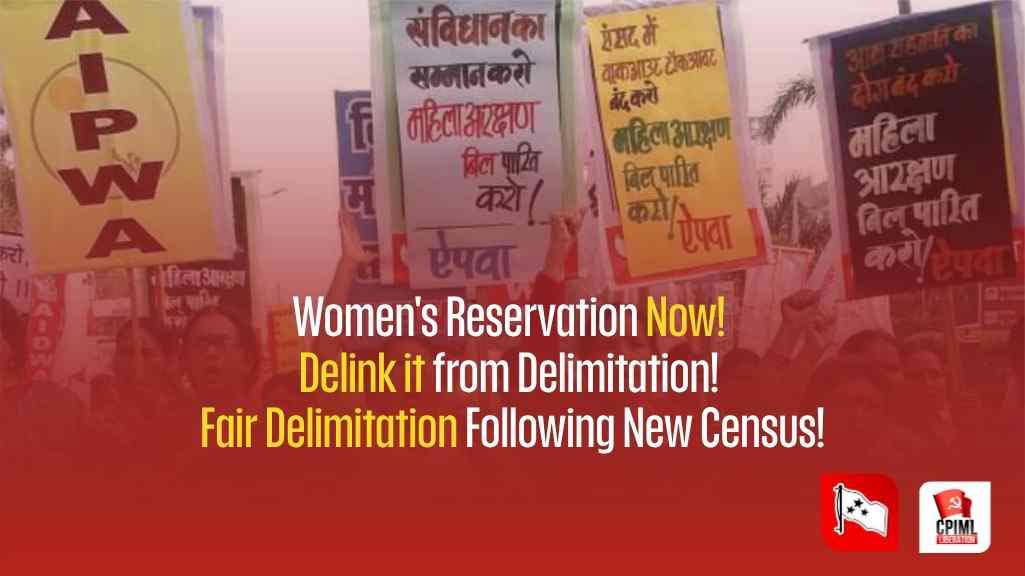
The biggest lie being peddled by the Modi government and the Sangh brigade is that the opposition has blocked the implementation of women's reservation. Narendra Modi has termed the defeat of the delimitation bill a murder of the dreams of women, even terming it a female foeticide. In reality, the bill on women's reservation was unanimously passed in Parliament in September 2023 and the BJP has to explain what it has done so far towards its implementation. It was the Modi government which had unnecessarily included the Census and delimitation as prerequisites for women's reservation in Parliament and Assemblies. With little progress on the Census front, the government now sought to hold women's reservation hostage to a dubious and utterly opaque delimitation exercise delinked from the census. It is this devious design that has now been exposed and defeated. The women's reservation bill passed in Lok Sabha and Rajya Sabha on 20 and 21 September 2023 remains very much in force as the 106th Amendment to the Constitution.
No previous introduction of reservation, whether political reservation or reservation in other spheres to SC/ST communities, OBC reservation in employment and education or women's reservation itself in panchayats and municipalities has been contingent upon an increase in the overall strength of Parliament, Assemblies or panchayats and municipalities, or number of available places in the arena of employment or education where such reservation was applied. The idea that one-third reservation for women could be done only by creating an extra space and not in the existing space trivialises the very idea and purpose of women's reservation. The bills that have now been defeated and withdrawn made it very clear that women's reservation was only being used as an excuse for an arbitrary and sinister scheme of delimitation.
It is true that the 84th Amendment Act, passed by the Vajpayee government in 2001, had extended the freeze of parliamentary strength decided in 1976 by another twenty-five years and accordingly the next round of delimitation is due after the first census conducted after 2026. It so happens that the 2021 census itself was delayed and work for the new census began only in 2026. The government sought to delink the next round of delimitation from this current census and hence from any consideration of the caste count that the new census is expected to produce. In fact, it sought to make any future delimitation exercise entirely opaque and arbitrary where the government of the day could get any design of delimitation executed with a simple parliamentary majority. The reason why the parliament's strength was frozen in 1976 and the freeze was subsequently extended by the Vajpayee government in 2001 was to minimise the effect of India's skewed population growth pattern on the parliament configuration. Any unqualified unfreezing of the numbers is liable to drastically tilt the regional balance of the parliament in favour of a few North Indian states to the neglect of the rest of India.
The so-called guarantees peddled by Modi and Shah in their speeches regarding maintaining the current proportion of states and regions were conspicuously missing in the actual text of the bills. In a parliament of 850 members drawn on the basis of the 2011 census, the southern states were liable to see their representation drop from 24.3% to 20.7%, the eastern states from 14.4% to 13.7%, the north-eastern states from 4.4 to 3.8 while the Hindi heartland states of UP, Bihar, MP, Chhattisgarh, Rajasthan, Haryana, Uttarakhand and Delhi would have had their share surge from 38.1% to 43.1%. There was absolutely no logical explanation in the bills as to how the new numbers - 815 for states and 35 for Union Territories - were arrived at. On a matter as delicate as delimitation that called for a transparent and rational democratic process of consensus-building to strengthen India's unity in diversity and the federal balance, the Modi government displayed a most casual and conspiratorial approach - convening a special session right in the middle of Assembly elections and furnishing the copies of the bills just on the eve of their presentation in Parliament to minimise the scope for study and scrutiny.
The Delimitation Commission enjoys greater constitutional powers than even the Election Commission. Once finalised, the delimitation formula is beyond the ambit of any parliamentary scrutiny or judicial review. And the Commission has the power not just to determine the size of Parliament or Assemblies, but also to draw the boundaries of constituencies. The delimitation exercise has already played havoc in Jammu and Kashmir and Assam, redrawing constituencies and using the SC/ST reservation formula in a manner guaranteed to erode the opposition's chances of winning and structurally weaken the say of the religious and linguistic minorities in the legislative arena. A pan-India replication of the J&K and Assam pattern of delimitation will render the electoral field of India utterly skewed in favour of the BJP's majoritarian anti-minority politics. Instead of being a rational process of updating, delimitation would degenerate into the most sinister form of gerrymandering where opposition votes are packed into a smaller number of constituencies or cracked (dispersed) widely to lose their critical numerical effect.
When such a devious delimitation design is executed in combination with a curated electoral roll and synchronised elections with Assembly polls being robbed of their autonomous context and reduced to extensions of the Lok Sabha elections (as proposed under the One Nation, One Election formula), all overseen by a handpicked election commission, the electoral system of India will produce a permanent settlement of power for the BJP much like the colonial era 'permanent settlement' of revenue that had institutionalised landlordism in India. The defeat of the delimitation bill in Parliament marks just an initial setback for this sinister design. India must now reject this design decisively. We need a powerful countrywide movement to press for immediate implementation of women's reservation on the basis of the existing strength of Parliament and Assemblies, early conclusion of census and publication of the caste data, and evolution of a national consensus on the next round of delimitation to reconcile representation on various levels with the federal democratic character of the republic. The special session of Parliament has exposed and checked a key game plan of the fascists, we must now carry the message far and wide among the people on a war footing.