
Every year, the Rashtriya Swayamsevak Sangh observes Vijaya Dashami as its foundation day. This year the foundation anniversary, which also marked the centenary of the organisation, fell on the second of October, the day India always celebrates Gandhi Jayanti. On October 2 this year we thus had one of the most telling and bizarre ironies of modern India - celebration of the legacy of India's best-known international icon and glorification of the very organisation which was banned for its role in his assassination. What makes the irony all the more glaring is the role reversal inflicted on the Indian state between then and now.
In February 1948 independent India's first Home Minister Sardar Patel banned the RSS immediately after the assassination of Mahatma Gandhi declaring the need and the Indian state's resolve "to root out the forces of hate and violence that are at work in our country and imperil the freedom of the Nation and darken her fair name". And in 2025, the Modi government led the RSS centenary celebration from the front, turning it into a state-sponsored celebratory occasion, issuing a postage stamp and a commemorative coin and unleashing a laudatory publicity blitzkrieg by various government depatments and institutions. Narendra Modi, who had termed the RSS as the biggest NGO in the world in his 2025 Independence Day address, used the centenary celebration platform to eulogise the organisation as the contemporary actualization of India's eternal national consciousness.
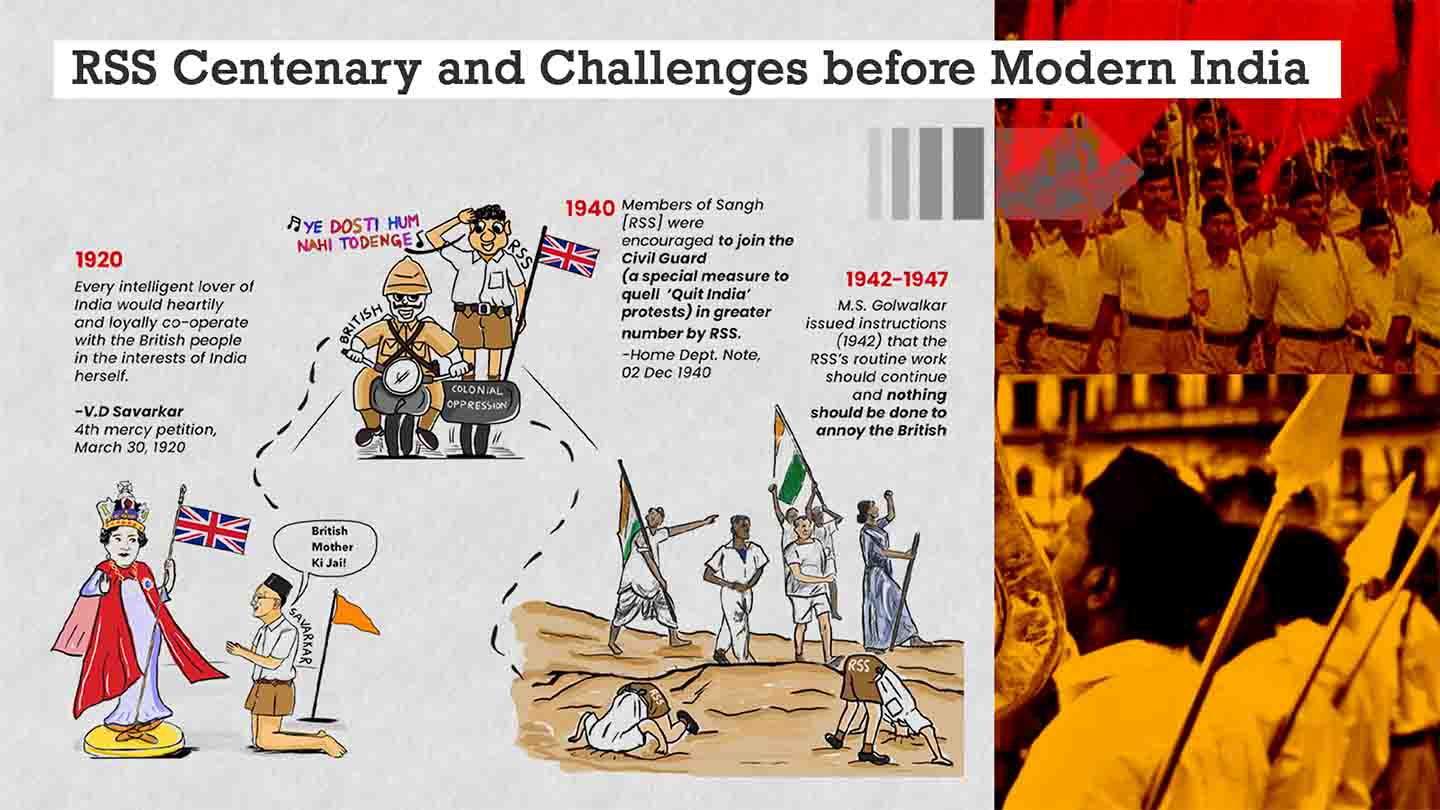
Modi also made a ridiculous attempt to link the RSS with India's freedom movement. He cleverly mentioned the fact that Dr Keshav Baliram Hedgewar had gone to jail during the freedom struggle but omitted the crucial fact that his first stint in the jail had happened in 1921-22 when he was associated with the Congress and the RSS was yet to be founded, and during his subsequent arrest in 1930-31 he had made it clear that his participation in the satyagraha was in his individual capacity and not on behalf of the organisation. Among the other well known Hindutva icons of that period, Savarkar is infamous for his mercy petitions and alleged role in the Gandhi assassination plot while Shyama Prasad Mukherjee collaborated with the British colonial rulers during the 1942 Quit India movement.
During the Vajpayee era an attempt was also made to link Vajpayee with the 1942 movement and project him as a hero of 1942 because of his arrest from his ancestral village Bateshwar in Madhya Pradesh and incarceration for twenty-odd days. But when reports indicating his collaboration with the police began to surface, Vajpayee denied any association with the movement and preferred to describe himself as a spectator and not participant, as just part of the crowd. The history of India's freedom movement in every part of the country presents the same picture of RSS aloofness from the movement. It was a well thought out strategy of the RSS to avoid any confrontation with the colonial state and use all its time and energy in building the organisational network and spreading the RSS ideology of Hindu nationalism. But today from the vantage position of state power, the Sangh brigade is busy rewriting history to teleologically bring Hindutva centrestage and push secular nationalism to the margin.
This desperation to win the battle of history is also reflected in the relentless RSS attempt to teleologically isolate and corner Nehru and hijack other major influential icons through selective misappropriation of their messages and historical roles. Gandhi and Ambedkar are two most striking targets of this Sangh strategy of misappropriation. We have seen the much attempted use of Gandhi in the recent past as a symbol of 'swachhta' or cleanliness. Now with the Trump tariffs hitting India's foreign trade, there is a renewed attempt to use the Gandhian metaphor of 'swadeshi' and 'swavlamban' - self-sufficiency and self-reliance. While Gandhi's overt use of Hindu religious metaphors makes him an attractive target of acquisition, his relentless invocation of Hindu-Muslim unity and communal harmony as the foundation of India's strength and national unity remains a total anathema to the Sangh's ideological discourse.
More than any other figure of history, the Sangh seems desperate to distort Ambedkar and blunt the edge of his egalitarian appeal and harness the power of the Constitution to subserve the fascist agenda. Former President Ramnath Kovind flaunted his Dalit identity and the legitimacy that comes from having occupied the presidential office to declare RSS compliant with the Ambedkarite ideology. Quoting a Vajpayee speech of 2001, he said that not Manusmriti, but Bhimsmriti, the Constitution, will continue to guide India's journey. He even described the RSS as a Bhimvadi or an Ambedkarite organisation. Ambedkar, who had identified caste as the biggest anti-national obstacle, called for annihilation of caste and described the prospect of Hindu Raj as the greatest ever calamity to befall India, is today being invoked by RSS ideologues as a proponent of social homogeneity and administrative centralisation.
The constitutional safeguards for cultural diversity, federal powers, minority rights and civil liberties are being systematically curtailed and even reversed to rob the Constitution of its egalitarian and libertarian thrust and turn it into a weapon of majoritarian rule, hyper nationalism, over centralisation and invasive surveillance. The empty lip service to Gandhi and Ambedkar, the rewriting of the history of the freedom movement and the constant abuse of the Constitution in the name of its enforcement, is the most sinister move of the Sangh-BJP establishment in the RSS centenary. The organisation which had explicitly rejected the Constitution at the time of its adoption, denounced the tricolour as a bad omen and fomented hate and violence that resulted in the assassination of Gandhi and persecution of Ambedkar, is today busy reconstructing India according to its own ideological imagination. This is perhaps what Modi indicated by quoting Hedgewar, "Take people as they are, shape them into what they should be". If India has to realise the constitutional vision of a sovereign socialist secular democratic republic, we the people of India will have to reclaim the Constitution and the radical inclusive and transformative legacy of the freedom movement and push the RSS back to the periphery where it belonged for much of its century-old existence.