


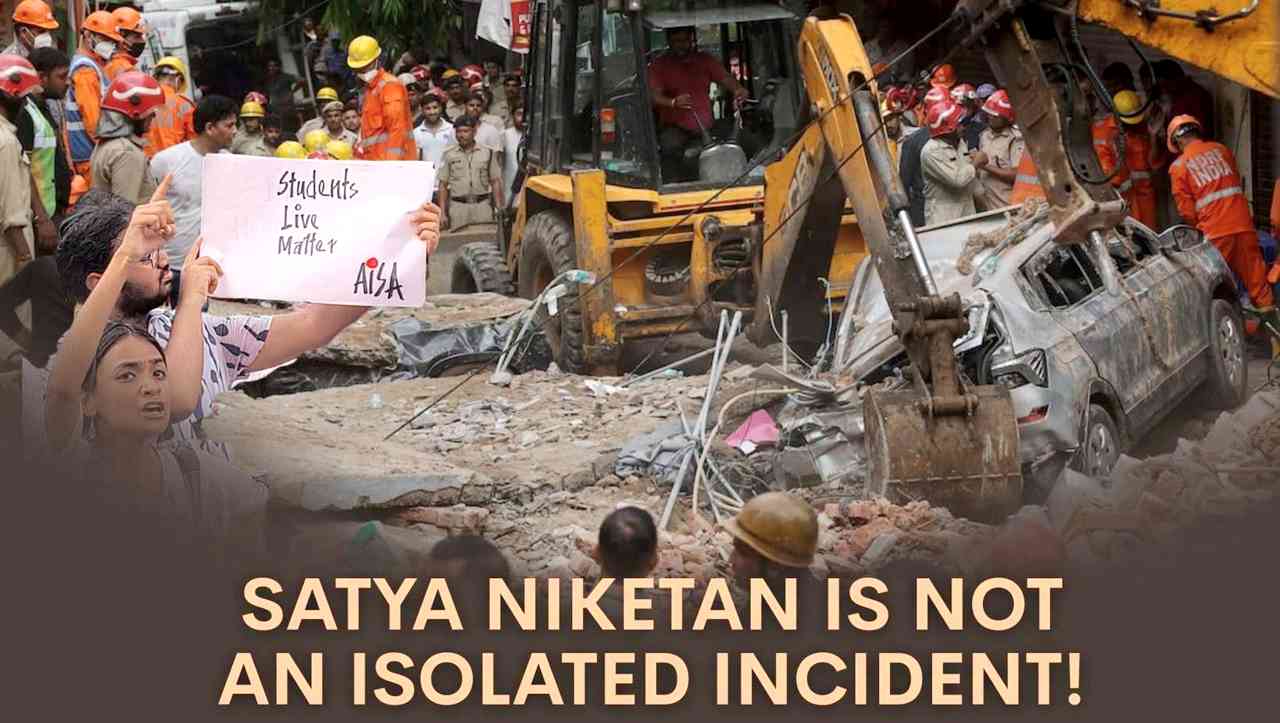
On Sunday afternoon, September 6, a Paying Guest (PG) building housing several Delhi University students in Satya Niketan, near the University’s South Campus, completely collapsed, leaving 7 people dead and many others injured, including workers engaged in renovation work being carried out by the owner.
An AISA delegation, led by AISA DU President Anjali, visited the site immediately after the collapse. On September 7, AISA, along with DU students, organised a candlelight vigil at Satya Niketan in memory of their classmates who lost their lives in the tragedy and expressed solidarity with those injured and the families of the victims. Comrade Sucheta De, Central Committee Member of CPI(ML) Liberation, also visited the students’ sit-in at South Campus, where students are demanding justice for those affected by the Satyaniketan building collapse. She pointed out that while the government has money to bail out corporates and provide them with tax relief, thousands of DU students are forced to live in rented PGs at exorbitant costs due to the severe lack of hostel accommodation across both the North and South Campuses of the University and its colleges.
Sucheta said that the repeated tragedies and deaths are institutional murders under a regime of impunity, profiteering and complete lack of accountability. Taking responsibility for these repeated deaths, Delhi Chief Minister Rekha Gupta, along with the MCD Mayor and the Vice-Chancellor of Delhi University, must resign.
She added that the government must provide Rs. 1 crore in compensation to the families of every student and worker who died, as well as to all injured students and workers. The government must bear the full cost of medical treatment and rehabilitation for all those injured, provide free higher education to injured students, and ensure permanent jobs for injured workers and one family member of every student or worker killed in the incident. Hostel accommodation must be provided to all students.
The Future of Delhi and the Lives of Its People Are in Peril
The Satya Niketan collapse is not an isolated incident but a stark reflection of the wider urban catastrophe facing Delhi. This tragedy comes just months after the Saidulajab PG collapse, in which six students, including several preparing for NEET, lost their lives, and the massive fire at a B&B in Hauz Rani in June, in which 23 people died.
A large section of Delhi’s population lives in buildings that are in disastrous and unsafe conditions, with a complete lack of basic amenities, while facing uncontrolled and exploitative rents. Whenever a tragedy occurs, those in power run amok with bulldozers, evicting the poor and destroying their homes and livelihoods for media propaganda, while no comprehensive and concrete long-term action is taken. These are only some of the most visible instances of the everyday tragedies faced by Delhi’s people, ranging from contaminated drinking water and deaths in sewers to toxic air pollution and more.
How many more people must die under the rubble of collapsed buildings or lose their lives in preventable fires before the government wakes up? How many more families must lose their homes, livelihoods and loved ones before there is accountability?
The need of the hour is a people-centric approach. CPI(ML) Liberation calls for the following:
1. The government must urgently undertake a scientifically planned, structurally sound, large-scale public housing construction programme with in-situ rehabilitation and without evictions, implemented through a phased, risk-based approach, to provide safe and dignified housing to the people who keep this city running day and night, as well as to the generations who will shape its future.
2. Urgent construction and expansion of hostel facilities by the government, colleges and universities must also be initiated to ensure adequate, safe and affordable accommodation for every student.
3. A common people-centric and scientifically planned Master Plan, integrating large-scale public housing with accessible and proper civic amenities such as public schools, public healthcare facilities, clean water, modernised drainage systems, well-connected and affordable public transportation, and sufficient green and open spaces for all, is essential to reversing Delhi’s rapid deterioration. Only such a comprehensive, people-centred approach can create a safer, more liveable and sustainable Delhi for everyone.
4. Public participation in planning: Workers, students, local communities and civil-society organisations should have a meaningful role in planning and monitoring Delhi’s housing and urban-development policies.
The reign of the mafias, backed and nurtured by those in power, must end. So must the reign of apathy, negligence and impunity towards people’s lives. Delhi needs a people-centric approach that puts public welfare above profit and cares for the lives, dignity and well-being of those who shape and build this city every single day.


