
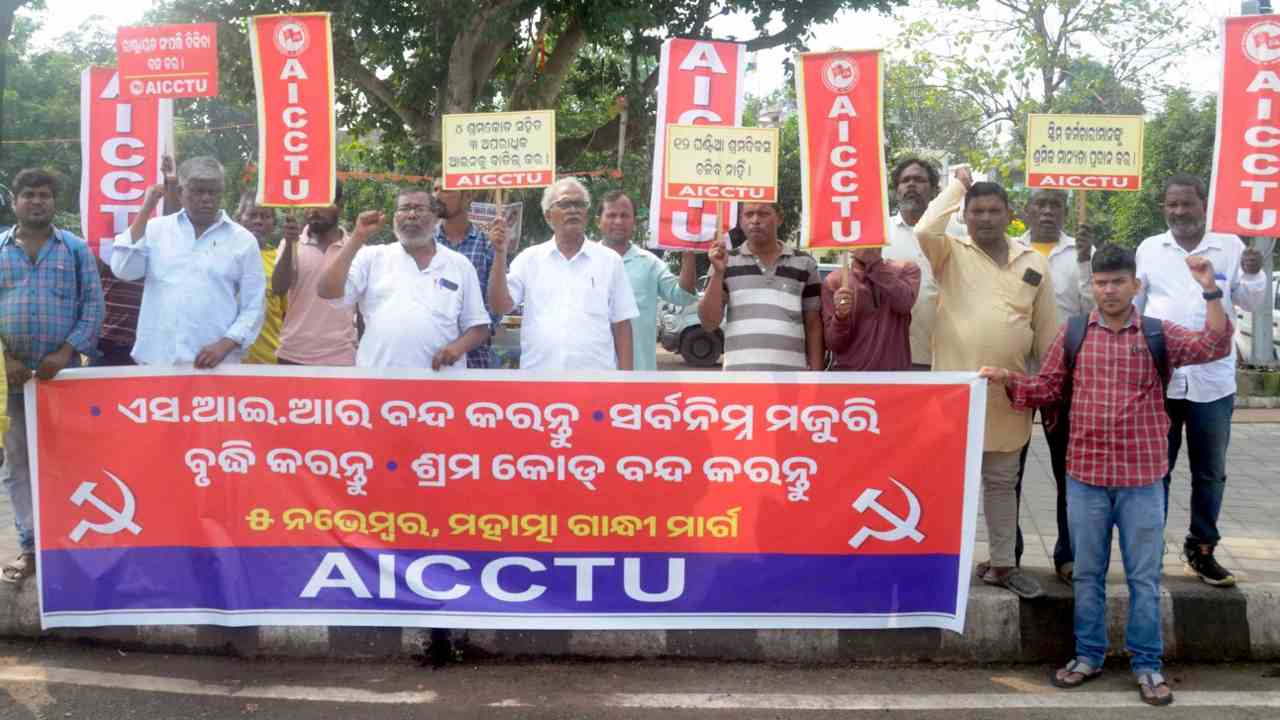
The All India Central Council of Trade Unions (AICCTU) organised a protest demonstration at Gandhi Marg in Bhubaneswar, the capital of Odisha, on Friday, 6 November, demanding the scrapping of the Special Intensive Revision (SIR) of electoral rolls, repeal of the four Labour Codes, a minimum monthly wage of Rs. 42,000 and an end to attacks on workers' rights and democratic freedoms.
Addressing the gathering, AICCTU Odisha State President Radhakant Sethi condemned the BJP-led Union government's anti-worker policies and its systematic attacks on labour rights won through decades of working-class struggles. They said that the four Labour Codes were designed to favour corporate interests by weakening legal protections for workers, undermining trade union rights, restricting the right to strike and collective bargaining, and increasing insecurity in employment.
The AICCTU State General Secretary Mahendra Parida highlighted the growing exploitation of contract workers, construction workers, railway workers, sanitation workers, industrial workers and those employed in the unorganised sector. They pointed out that millions of workers continue to face low wages, irregular payments, unsafe working conditions, lack of social security and arbitrary retrenchments. Instead of strengthening labour protections, the government is seeking to dismantle the rights secured through generations of workers' struggles.
The demonstration demanded the repeal of all four Labour Codes and the protection of workers' rights under labour legislation. The union also called for a minimum monthly wage of Rs. 42,000 for all workers, strict enforcement of the eight-hour working day and double wages for overtime work. Other demands included Employees' Provident Fund (EPF), Employees' State Insurance (ESI), statutory bonuses, gratuity and paid leave for eligible contract and temporary workers, equal wages and safe working conditions for women workers, and adequate social security and protective equipment for sanitation, construction and unorganised-sector workers. The protesters also demanded protection of trade union rights, collective bargaining and an end to arbitrary suspensions, victimisation and harassment of contract workers.
Rejecting the arbitrary SIR of electoral rolls being carried out by the Election Commission of India, AICCTU leaders warned that the exercise threatened to disenfranchise large sections of the working people. They pointed out that poor households, migrant workers, Dalits, Adivasis, women and elderly citizens were particularly vulnerable to exclusion because of documentation requirements and administrative obstacles.
The demonstration brought together workers, trade union activists and representatives of democratic movements. The demonstration also condemned police repression, intimidation, false cases and harassment targeting workers, peasants, Adivasis and democratic activists in different parts of Odisha. The speakers demanded an immediate end to police atrocities and arbitrary action against peaceful protesters, asserting that the right to organise, assemble and protest was essential to democracy and could not be curtailed by the state.