
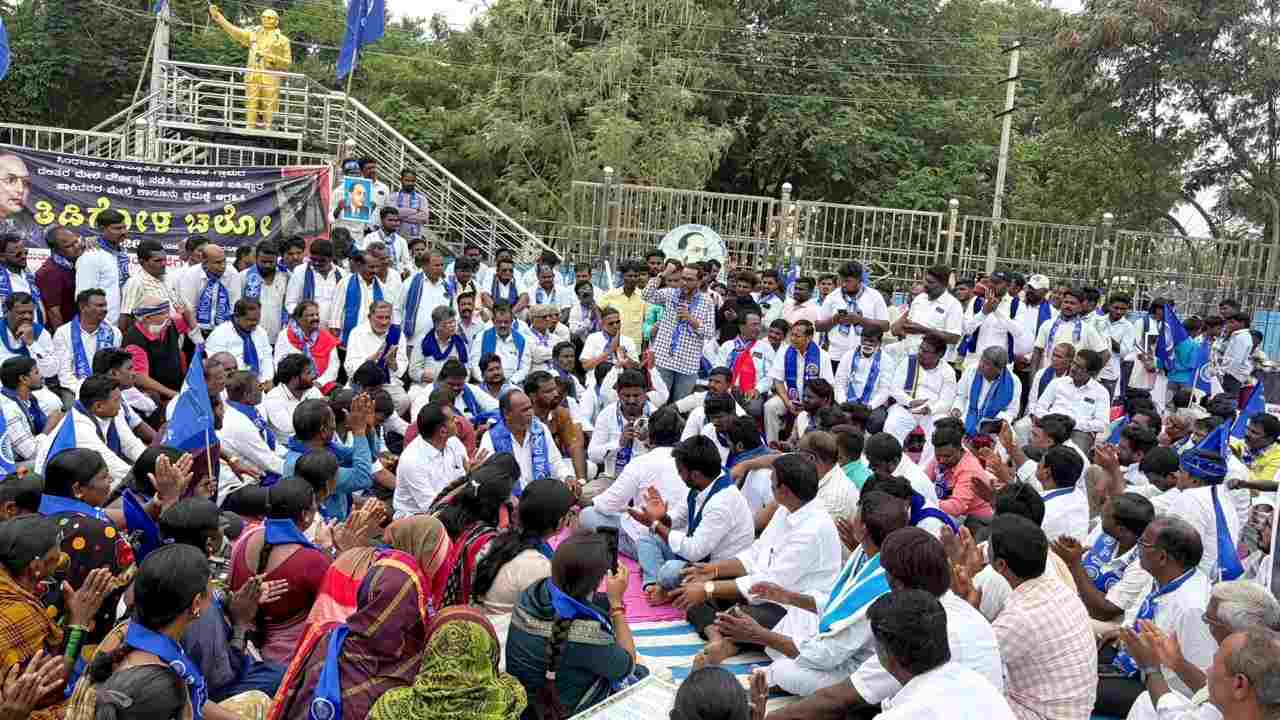
Thousands of people defied prohibitory orders and heavy police deployment to participate in the Thidigol Chalo protest in Sindhanur, Raichur district, Karnataka, on Sunday, 8 November, demanding justice for Dalit families subjected to brutal caste violence and social boycott in Tidigol village. The protest, organised by Dalit and progressive organisations, brought together workers, peasants, women, students, youth and democratic activists from across Raichur district and other parts of Karnataka. CPIML Liberation State Secretary Clifton also joined the march.
The inhuman structure of caste, which Babasaheb Ambedkar called a "disease of the mind", is the inescapable daily reality of Indian society. The immediate 'reason' was that Dalits 'dared' to participate in the village Anjaneya fair on 18 October 2026. A group of upper-caste men stopped them from joining the procession and when the Dalits questioned them back, the dominant caste Lingayat men severely assaulted them. They chased the Dalit youth as they ran to the Dalit locality (keri), shouting for help; hundreds of upper-caste men chased him and assaulted the men, women and elderly persons who tried to intervene. Shri. Tayappa, a lecturer, and other Dalit educated youth were particularly targeted and violently beaten up.
The usual tactic of filing counter cases against the Dalits who were at the receiving end of the violence was deployed, and the local police did their best to help the perpetrators rather than the Dalits..
More than two weeks after the attack, the main accused had still not been arrested, while several Dalit residents had been forced to leave their village out of fear. Dalit and progressive organisations condemned the negligence of the police and district administration, holding them responsible for the continuing insecurity faced by the affected families.
Against this backdrop, the organisations announced the Thidigol Chalo programme, including a public demonstration and motorcycle rally, on 8 November to demand justice and an end to caste atrocities and social boycott.
In an attempt to prevent the mobilisation, the district administration and police imposed prohibitory orders under Section 163 of the Bharatiya Nagarik Suraksha Sanhita (BNSS), the provision that replaced Section 144 of the earlier Code of Criminal Procedure. The restrictions effectively sought to prevent the public protest and rally demanding justice for the Dalit victims.
Despite these restrictions and the deployment of a large police force, thousands of protesters gathered and took out a massive motorcycle rally. Dalit organisations, progressive groups, trade unions, peasant organisations, women's groups, student and youth organisations, and people from different communities joined the mobilisation from every taluk of Raichur district and several other parts of Karnataka.
The attack in Tidigol once again exposed the deeply entrenched structures of caste oppression in Indian society. The violence against Dalits for asserting their right to participate in a village religious procession reflected the continuing denial of equality and dignity to Dalit communities, even decades after the constitutional abolition of untouchability.
The Thidigol Chalo mobilisation reaffirmed that the struggle would continue until the victims secured justice and those responsible were brought to account. The protesters pledged to carry forward the fight against caste atrocities, untouchability and social exclusion, and to advance Babasaheb Ambedkar's vision of the annihilation of caste.