
The BJP’s eventual capture of power in West Bengal was achieved not through a free and fair democratic mandate, but through a calculated and systematic subversion of the entire electoral process. The Election Commission was reduced to an obedient instrument of the ruling regime, facilitating an unprecedented assault on democratic rights and constitutional norms.
The four-month-long “Special Intensive Revision” (SIR) exercise culminated in the disenfranchisement of nearly 9.1 million voters. Simultaneously, over 2 lakh 40 thousand central paramilitary personnel were deployed across the state in an atmosphere resembling military occupation rather than an election in a parliamentary democracy. Bulletproof battle vehicles paraded through towns and villages, while large sections of the mainstream media manufactured consent for this authoritarian takeover. Reports of intimidation at counting centres and deliberate disruption of transparency further exposed the extent to which the electoral process had been rigged in favour of the BJP. All this unfolded amidst genuine anti-incumbency sentiments against the Mamata Banerjee regime, which the BJP tactfully weaponised to impose its own authoritarian project.
Soon after assuming power, the BJP-RSS combine unleashed a coordinated campaign of intimidation and symbolic domination following the notorious Tripura model. Statues of Lenin and Sidho-Kanhu were vandalised and desecrated. Bulldozer rallies were organised to terrorise minority communities, demolish Muslim-run eateries, and target squatter colonies inhabited by the poor. A climate of fear and persecution was systematically cultivated.
Alongside this naked coercion came an aggressive ideological offensive. The Sangh Parivar intensified its attempts to appropriate the towering figures of the Bengal Renaissance — Swami Vivekananda, Bankim Chandra Chattopadhyay, Rabindranath Tagore, Raja Rammohan Roy and others — stripping them of their universal, humanist, and anti-sectarian legacies in order to fit them into a narrow majoritarian framework. At the same time, the regime openly glorified the communal politics of Shyama Prasad Mukherjee, one of the principal architects of the Partition of Bengal and founder of the Jana Sangh in 1951, thereby legitimising the divisive politics of communal polarisation.
In the face of this escalating fascist aggression, the Left and democratic forces of Bengal resolved not to surrender. Braving intimidation, violence, and vandalism, the West Bengal State Committee of CPI(ML) Liberation issued a call to all Left parties, democratic organisations, and conscientious citizens to unite in resistance.
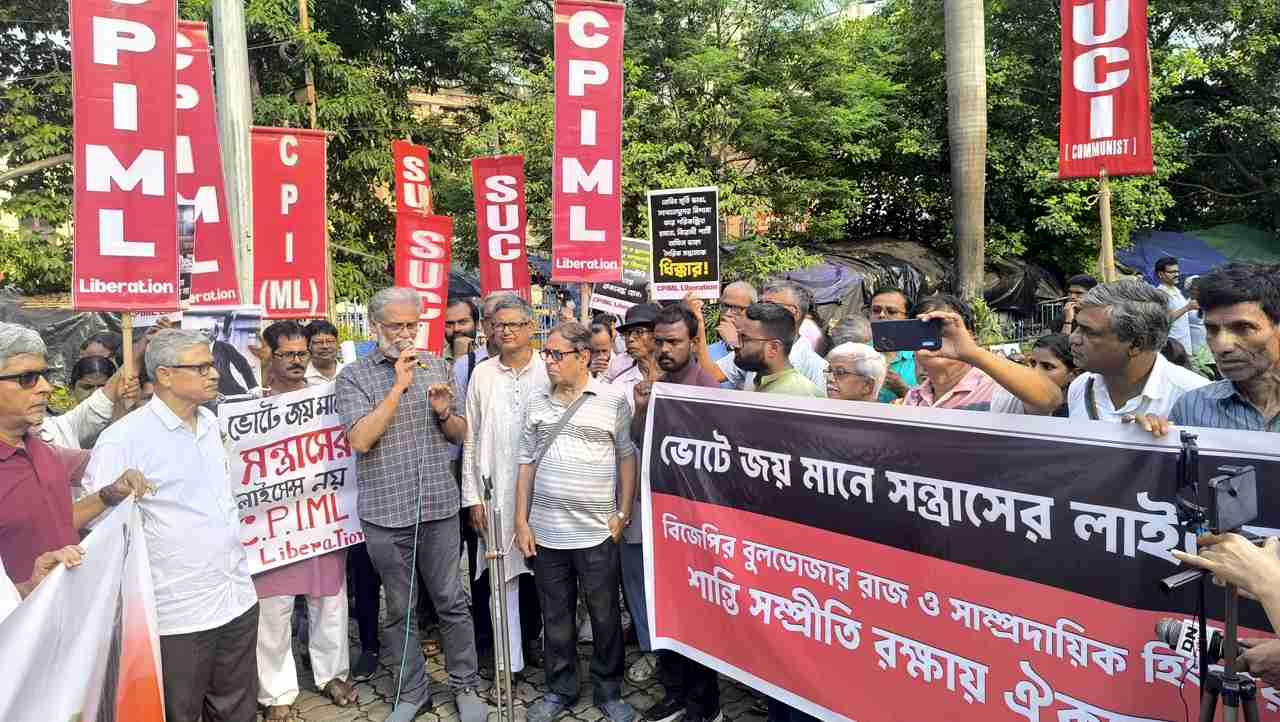
Responding to this appeal, a protest mobilisation was organised on 7 May in Kolkata and across several districts. In Kolkata, activists of CPI(ML) Liberation, SUCI(C), and numerous democratic individuals from civil society assembled before the historic Lenin statue at Dharmatala — itself a symbolic target of the saffron forces. The gathering became a powerful assertion of secularism, democracy, and Left unity.
The protest meeting was addressed by Comrade Dipankar Bhattacharya; Comrade Chandidas Bhattacharya, State Secretary of SUCI(C); journalist Arka Bhaduri; cultural activist Joyraj Bhattacharya; Comrade Sankar of CPI(ML) Red Star; and several other prominent voices of resistance. Speakers condemned the authoritarian takeover of Bengal and called for a broad-based democratic struggle against fascism and communal hatred.
The next day on the 8th a massive protest rally organised by the left front constituents and CPIML took to the streets raising slogans against saffron vandalism and for securing the rights of the minority community, mostly the poor shop owners whose livelihood got smashed under the buldozer brigade.
The mobilisation gathered further momentum on 9 May — the day the saffron government was sworn into office. A citizens’ rally was organised in conscious remembrance of the historic anti-partition procession led by Rabindranath Tagore in 1905, from Bagbazar to Nakhoda Masjid, against Lord Curzon’s attempt to divide Bengal along communal lines. Reclaiming that historic legacy, the rally emphasised Hindu-Muslim unity, social harmony, and resistance to communal polarisation at a moment when the BJP-RSS ecosystem was relentlessly targeting minorities and attempting to fracture Bengal’s composite culture.
The new regime responded in the only language authoritarianism understands: repression. The rally was intercepted by the police administration at Bagbazar itself. Yet the participants remained undeterred. Protest songs filled the streets, public speeches continued defiantly, and the spirit of resistance refused to bow before state intimidation.
These protests resonated widely among the people of Bengal. They drew support from conscientious citizens, cultural activists, students, workers, and democratic sections across society who recognised the grave danger posed by the rise of fascist politics in the state. Similar protest rallies and solidarity gatherings were organised in several major district headquarters, signalling that the struggle against communal authoritarianism and corporate-backed fascism had only begun.
The battle for Bengal today is not merely an electoral contest. It is a struggle to defend democracy against authoritarianism, pluralism against communal hatred, and the emancipatory traditions of Bengal against their ideological appropriation by forces of reaction. The resistance on the streets of Bengal marks the beginning of a broader democratic fightback — one that draws strength from the state’s long history of anti-colonial struggle, social reform, and Left movements.