
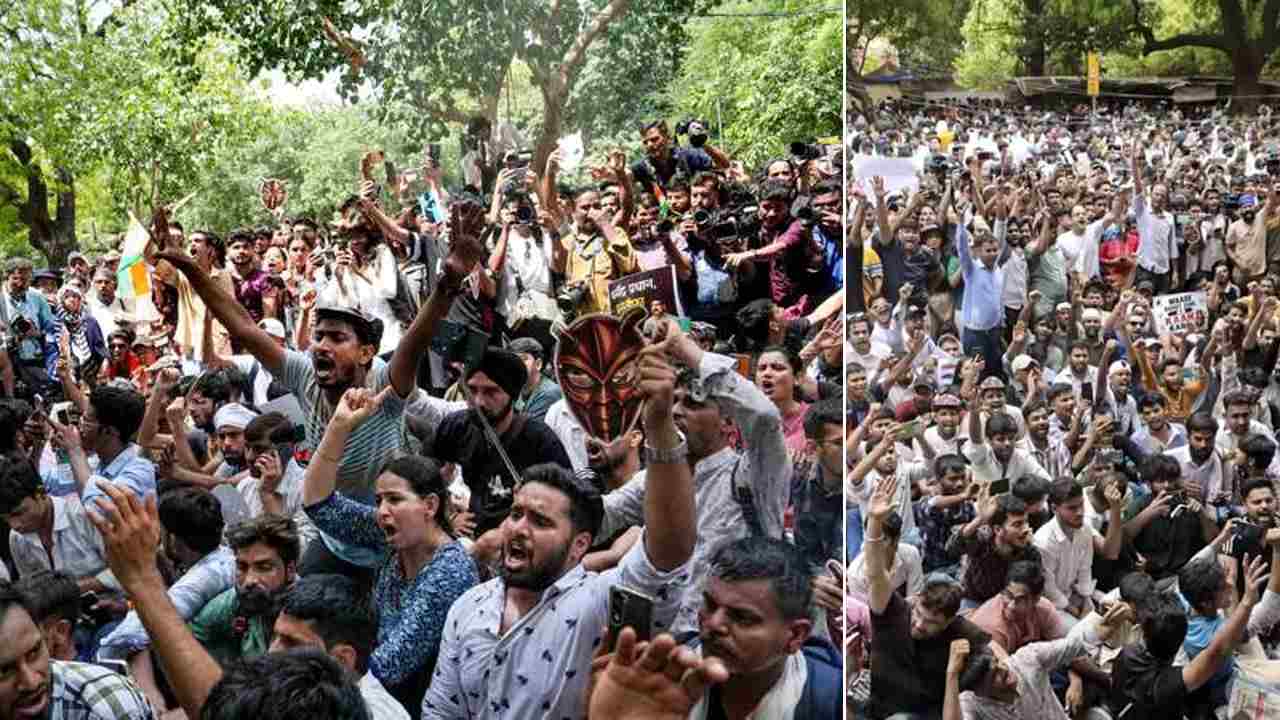
Five weeks of unprecedented youth protests have inflicted the biggest blow yet to the arrogance of the Modi government and the illusion of invincibility associated with Narendra Modi since his ascent to power in 2014. From horrific police brutalities to the whole range of techniques of perception management, the regime tried all possible tricks to protect the failed education minister, but for once nothing worked. Especially during the last one week, these attempts to halt the movement - from the early morning abduction of Sonam Wangchuk from Jantar Mantar on 18 July to Modi's repeated midnight video appeals after the shocking police repression on the historic Parliament march on July 20 - only backfired and added to the intensity and countrywide spread of the protests, leaving the government with no other option but to sacrifice Dharmendra Pradhan.
While the protest movement has achieved its most immediate demand, there is no pause in the atrocities and persecution directed against protesters across India. Hundreds of activists remain in the jails of Bihar and more people are being framed and arrested. Among prominent arrested leaders are former JNUSU General Secretary and reelected CPI(ML) MLA from Paliganj Sandeep Saurav, former JNUSU President Dhananjay Kumar, Bihar AISA leaders Saba Afreen and Dipankar, Patna University Student Union President Shantanu Shekhar and several others. In West Bengal, the BJP government is invoking the recently legislated draconian 'Goonda Suppression Act' to arrest participants, particularly targeting Muslim youth.
According to the CJP's declared understanding with the government, this is in violation of an assurance regarding release of all detained protesters and withdrawal of charges and cases slapped on them. There is also enough documentary evidence of the use of brute force and pellet guns by the Delhi police and of men in plain clothes beating up protesters in tandem with RAF personnel and other security forces. Bihar has reports of the police using AK47 assault rifles. RAF Inspector General Seema Dhundhia has reportedly in an internal review acknowledged the use of disproportionate, excessive and unnecessary force in the name of crowd control. Who will take accountability for this brazen violation of the police's own norms? Delhi Police operates under Amit Shah's Ministry of Home Affairs. There can be no end to the current phase of the movement without action against erring police officials, accountability of Amit Shah and implementation of a general amnesty for youth movement protesters across India.
The demand for the resignation of Dharmendra Pradhan arose as a measure of accountability for serial paper leaks during his tenure. The government now proposes to address the issue of paper leaks by setting up fast-track courts and providing for harsher punishment for those convicted. This so called 'fast track' recipe is actually no answer to the real malady of paper leaks. Just consider a few relevant facts. The National Testing Agency has just terminated 47 of its existing staff of around 200 without disclosing their names, ranks and alleged roles in the leaks. When one out of every four is suspected to be complicit in the leaks it raises questions about the integrity of NTA itself. It is high time that NTA was dismantled and replaced with a new agency governed by a parliamentary act and complying with norms of transparency and accountability.
Just when the government talks of setting up fast-track courts and increasing the quantum of punishment, a key accused of the 2024 NEET paper leak got a clean chit from the CBI. And let us also note that on the very day Narendra Modi announced his government's intention to set up fast-track courts to ensure 'swift and stringent punishment for those involved in paper leaks', his government disclosed some startling figures in the Rajya Sabha exposing the reality of fast-track courts in India. As in April 2026, more than 249,000 cases were pending before 775 fast-track special courts, including 398 courts set up exclusively to deal with cases under the Protection of Children from Sexual Offences (POCSO) Act.
The student-youth movement has also been demanding restructuring, if not replacement, of the centralised NEET examination system which has been undermining federal rights of states to conduct examinations keeping in mind their respective linguistic and educational conditions. There are also growing grievances against the exclusionary and discriminatory nature of the National Education Policy 2020, passed during the Covid era along with the farm laws and labour codes. The new policy has made higher education exorbitantly expensive for students from low-- and middle-income backgrounds and the arbitrary benchmarks for four year degree courses are forcing more and more students to drop out of college education before obtaining their degrees. Indeed the massive support behind the July 22 protest in Patna and July 25 Bihar Bandh called by AISA and RYA is rooted as much in the grievances against NEP and Bihar's crumbling education system as against NEET paper leak and the demand for Dharmendra Pradhan's resignation.
The Jantar Mantar protest highlighted the issue of 21 student suicides triggered by the NEET-UG 2026 paper leak. The government has now agreed to pay compensation to each of the victim families. But like debt-driven farmer suicides and microfinance-related suicides of women, student suicides have become a highly alarming phenomenon in recent years. There are at least 93 reported NEET-linked student suicides from 2021 to the middle of 2026. Beyond NEET if we look at student suicides in general, the NCRB figures indicate more than 123,000 student suicides from 2014 to 2024, the first ten years of the Modi era in India. Behind the explosion of youth anger or Gen Z discontent we have just witnessed digitally through the phenomenal rise of the CJP, electorally in the Tamil Nadu Assembly poll outcome or socially through the unprecedented spread and intensity of the Jantar Mantar protests, there is thus a long and varied pattern of deprivation, disillusionment and denial of basic rights.
The actual gain made by the Jantar Mantar protests may immediately be limited to the resignation of Dharmendra Pradhan, and increased attention to the much neglected and most urgent agenda of public education and the pivotal role of accountability in a functional democracy. But by heralding India's first Gen Z monsoon of protests, by creating a new vibrant culture, popular language and almost festive environment of people's assertion tearing apart the otherwise well entrenched web of hate and lies, fear and apathy, Jantar Mantar has opened up new vistas of democratic regeneration.
The announcement of amnesty by the governments of Bihar and Assam signals that the impact of the movement is still being felt. Let the impact grow in the coming days, and let new bonds of unity and solidarity be forged among various sections of society and fronts of struggle. Let the spirit of Jantar Mantar permeate across India and the voices of people's resistance for people's rights resonate far and wide.