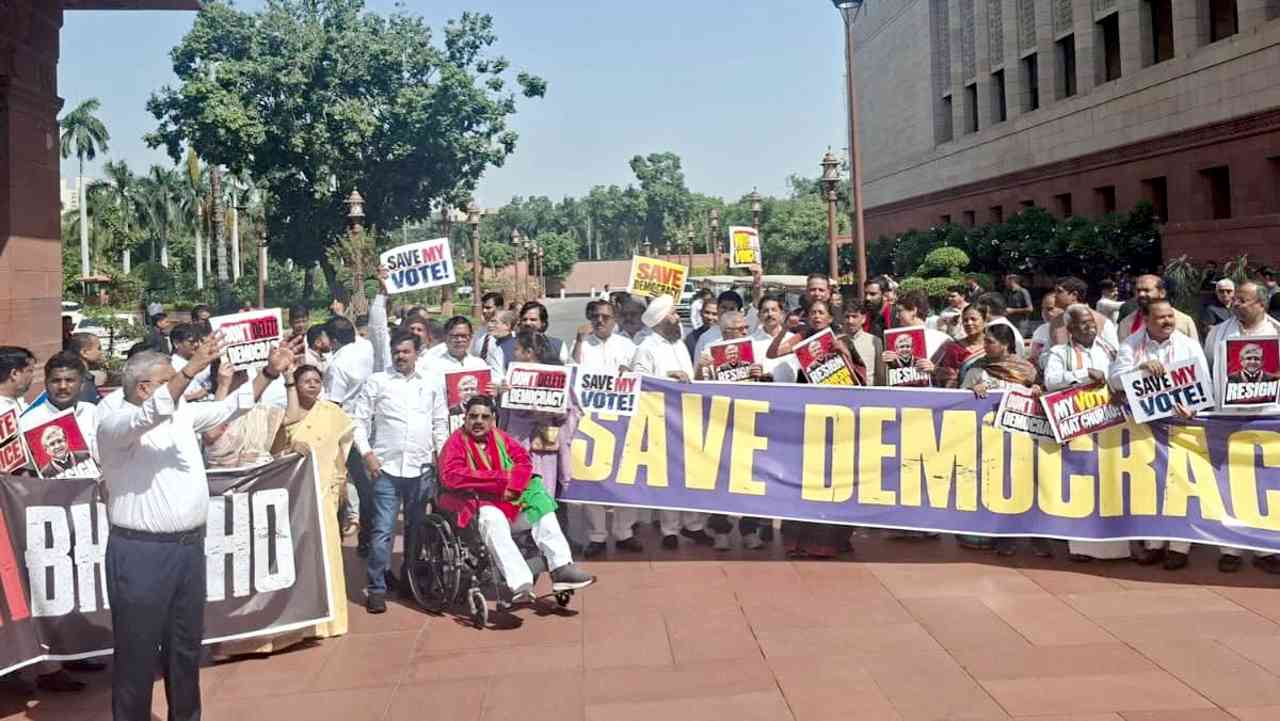

Never before in independent India has Gandhi Jayanti been celebrated as a day of protest by the people on this scale and in this manner. The whole world recognises Gandhi as an iconic leader who epitomised the power of peaceful mass protest of common unarmed people. That legacy of Gandhi came truly alive across India this year on Gandhi's 157th birth anniversary. Scenes like hundreds of student activists and other citizens defying the massive intimidating deployment of security forces around a fortified Jantar Mantar in Delhi and repeatedly being brutally arrested and escaping from police buses to rejoin the protests, or an entire crowd collectively singing the national anthem in Mumbai would remain etched in our memory for years to come. While the protesting people invoked the Gandhian legacy of peaceful protest, the government of the day resurrected the colonial model of governance by brute force.
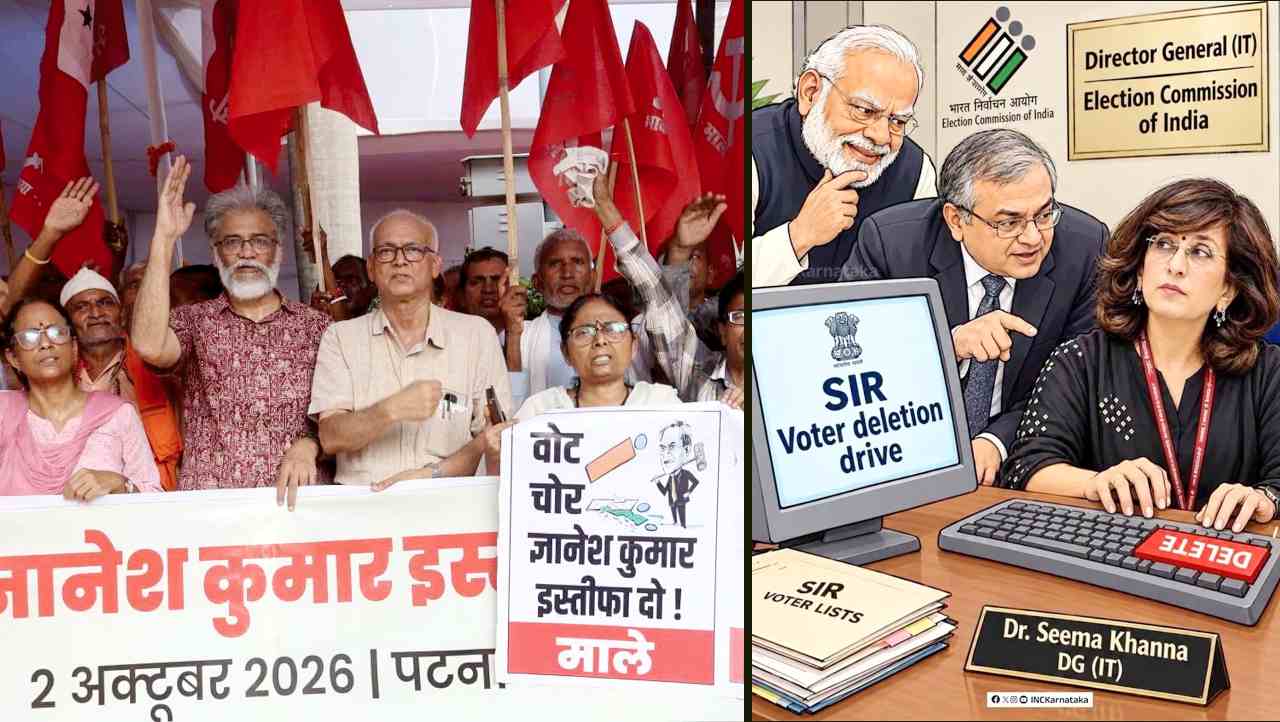
The call for immediate resignation of Gyanesh Kumar, scrapping of SIR and restoration of the voting right of every wrongfully deleted voter has now become the rallying point for citizens across India. It is also imperative to repeal the 2023 Act that gave the government of the day a free hand to choose its own election commission and granted lifelong immunity to the Election Commissioners, placing them above the ambit of law. The explosive investigative report published in the Indian Express and subsequent 'crisis management' and 'damage control' attempts by the Election Commission have only strengthened this long felt popular outcry. The Indian Express report had exposed the arbitrary and unilateral functioning of the CEC and the marginalisation of the other ECs within the ECI and the blatant centralisation of control and software manipulation in the name of cleaning up of the electoral roll through the SIR. Every circular being issued by the ECI now only testifies to the massive institutionalised fraud that has been inflicted on India's electoral democracy and the fundamental principle of universal adult franchise through the unconstitutional SIR drive.
Now that the whole country is talking about disenfranchisement of more than 130 million voters, the ECI has asked all CEOs to reach out to all 'left-out' voters within one month! Why has the ECI now woken up to the reality of mass exclusion of voters? The term 'left-out' in the ECI instruction is actually a euphemism for arbitrary and targeted exclusion, designed to tilt the electoral balance in favour of the BJP and its allies. Even as the EC was issuing this latest circular on 1 October, activists of CPI(ML) were holding a public hearing of excluded voters in Patna. A door-to-door verification survey between June and September in fifty select booths over ten of the twenty constituencies contested by the party in the 2025 Bihar Assembly elections was carried out by party activists who did precisely what the EC has now asked BLOs to do - identify excluded voters by comparing the post-SIR electoral roll with the pre-SIR June 2025 roll. The survey revealed a shocking wrongful deletion rate of 17 percent.
Two forms - Form 6 and Form 7 - have been weaponised by the BJP and the ECI to effect mass exclusion and selective inclusion of names in the electoral roll. Now that changes made in Form 6 have been exposed to have been arbitrary, unauthorised and illegal - effecting any change in the clauses of the form is an exclusive prerogative of the parliament - the EC has withdrawn the controversial clauses without any explanation. The EC's attempt to claim Supreme Court approval of changes made in Form 6 has now been refuted by CJI Suryakant himself. The changes were clearly made to obstruct the inclusion of Gen Z voters in the electoral roll. The ECI is also misusing the Form 6 which is meant to be an entry route for first-time voters with a legally verifiable undertaking by forcing excluded voters to fill it up for their reentry in the electoral roll. This is patently illegal and despite objection from day one the ECI has continued to persist with this malpractice.
More sinister has been the industrial-scale misuse of Form 7 to exclude eligible voters. There have been multiple reports of confiscation of bundles of pre-filled Form 7 targeted mostly against Muslim voters and voters likely to vote against the BJP and its allies. In each case of exclusion of voters in response to complaints filed on the basis of Form 7, concerned voters must get proper notices and opportunities to answer them. But this is hardly the experience of voters who have been victims of mass exclusion. The most shocking pattern of targeting and victimisation has been witnessed in West Bengal. Retired Justice Indrajit Chatterjee, who has now resigned as chair of Appellate Tribunal 11, has revealed that as many as 2.54 lakh Form 7 appeals were filed before his tribunal by none other than the Additional Chief Electoral Officer of West Bengal seeking exclusion of voters who had been found eligible even by judicial officers. According to the Indian Express investigative report, Election Commissioner Sukhbir Singh Sandhu had complained that neither he nor his fellow Election Commissioner Vivek Joshi or the CEO of West Bengal had any idea regarding the origin or authorisation of 16,10,311 exclusion appeals before the 19 West Bengal tribunals.
The institutional architecture of India's parliamentary democracy, the doctrine of separation of powers and the system of checks and balances that have been central to the survival of democracy in post-colonial India, are facing their gravest test. The Supreme Court which could and should have restrained the Election Commission virtually gave it a free hand to perpetrate this monumental electoral fraud. What would have been a shocking instance of blurring the legislature-judiciary boundaries, a meeting between the Joint Parliamentary Committee examining the One Nation, One Election bills and the Supreme Court proposed for 6 October, has just been shelved. With little institutional support, the survival of democracy in India now depends almost entirely on the maturity and alertness of the people of India, and the non-BJP political spectrum, civil society and alternative media they can count on at this critical juncture. The belated September 30 meeting of the India bloc and the growing assertion of Left student activists, other GenZ protesters, progressive citizens, alternative media activists and the non-NDA opposition parties signal the hope of a determined democratic turnaround, breaking the fascist stranglehold.