
Barely three months after celebrating Narendra Modi's 'record' as India's longest serving elected Prime Minister, the Modi government, various BJP-led state governments, and the entire Sangh-BJP establishment turned Modi's 76th birthday into a grand national spectacle. Never before has India seen such crude and brazenly coerced state-sponsored celebration of megalomania and personality cult. A huge unknown sum of public money was spent and institutional norms were misused in every possible way to force people to light lamps in honour of the birthday. In IIM Jammu, students not participating in the event have been slapped with fines.
Despite such coercion, the 'spectacle' however turned out to be a spectacular flop. For a beleaguered government facing popular opposition on every front for its utter failure, incompetence and apathy, there could be no spontaneous support for such enforced celebration. In fact, the festive drill of the regime seemed to be mocking India's immediate reality with vast areas battling floods and, just days earlier, students pigeonholed in an insecure paying guest accommodation in South Delhi being crushed to death in a building collapse that should actually be seen as an utter collapse of municipal governance.
Preceding the PM's birthday bash, Delhi hosted the 18th summit of BRICS countries. Over the years India's role in BRICS has become rather peripheral with the Modi era foreign policy virtually turning India into a strategic appendage of the US-Israel axis. India offered only a delayed muted condolence after the targeted assassination of Iran's supreme leader in a joint US-Israel airstrike and remains shamelessly quiet on both the war on Iran and the continuing genocide of Palestinians in Gaza. There was therefore little to the New Delhi BRICS summit except yet another photo opportunity for Narendra Modi to 'showcase' his much-hyped 'personal equation' with global leaders and a carefully drafted 'consensus' declaration which talked about reforms in the UN Security Council without any explicit condemnation of the US-Israel axis of war that currently poses the greatest threat to world peace and humanity.
Meanwhile even as the Modi birthday celebrations were on, the US threatened India yet again on the issue of oil purchase from Russia, this time with tariffs of up to 100%. The threat came in the form of a bill passed by the US House of Representatives giving President Donald Trump broad powers to impose sanctions on Russia and tariffs of up to 100% on countries buying oil and gas from Russia. In response to the tariff threat, the Modi government has formally responded by invoking India's 'independent foreign policy', but it is always action that speaks louder than words. And on that score, the government has yet again succumbed to American pressure.
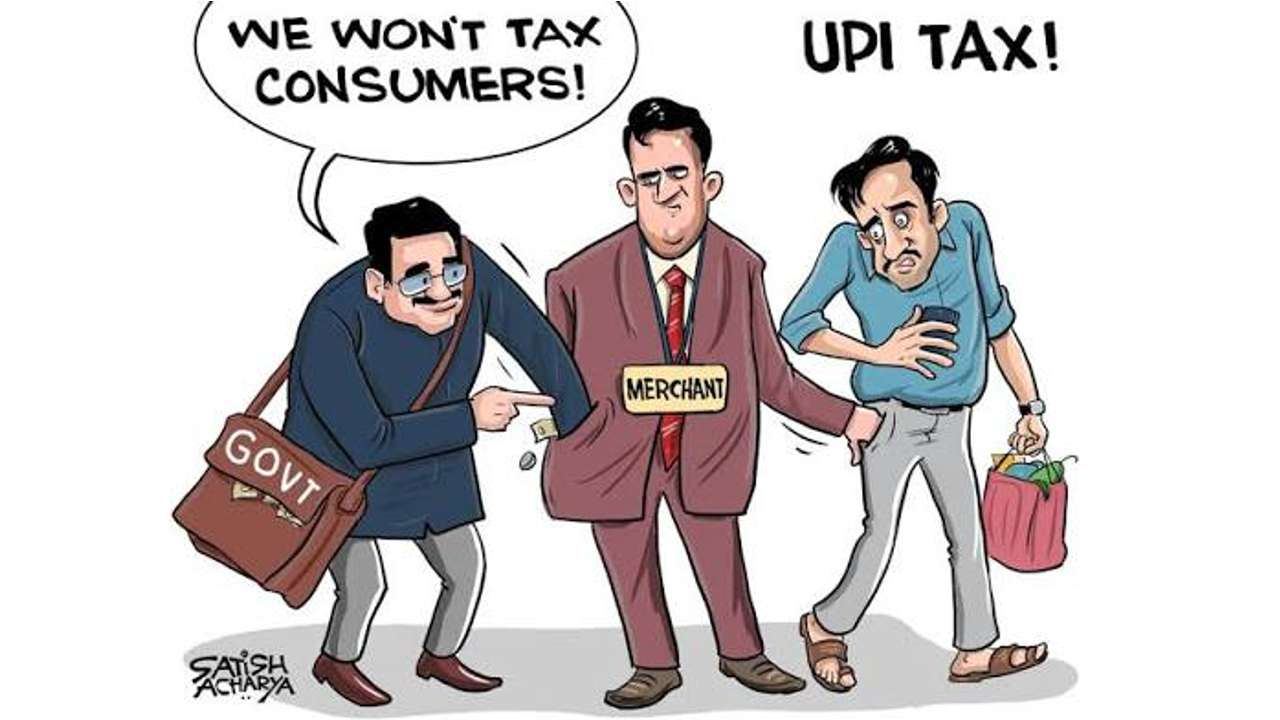
Nothing could indicate this more starkly than the latest extortionist tax diktat of the Modi government. Just after the conclusion of the BRICS summit in New Delhi and ahead of the lamp-lighting festival on Modi's birthday, the government announced 0.4% tax on every commercial payment above ₹2,000 through India's most popular digital payment platform, UPI or Unified Payments Interface. The tax has of course been camouflaged as a 'discount rate' and that too for 'merchants'. The 'discount' however refers to the threshold of payments below ₹2,000 which will still not attract any fee. And 'merchant' is only a codeword for consumers for no merchant is going to bear the tax burden without transferring it to the purchaser.
It is well known that US credit card giants Mastercard and VISA had long been complaining about India's free UPI payment system. The Modi government had launched the UPI system in April 2016, six months before the disastrous demonetisation move, and it gradually became India's biggest substitute for direct cash transaction. While the common people and the MSME sector bore the brunt of the massive disruption caused by demonetisation, there has been no dent in the black money that the withdrawal of the big notes was touted to curb. Indeed, the only tangible long-term effect of demonetisation has been the rise of UPI as India's default alternative to the use of cash. For the Modi government, the UPI was the biggest 'atmanirbhar' success story of digital India. Now with the introduction of the UPI tax, widely believed to be a precondition for India's ongoing trade deal negotiations with the US, the government itself will begin to disincentivise the use of UPI and promote the use of cash all over again.
Demonetisation was the Modi government's first application of 'shock therapy'. Delivered just before the UP Assembly elections of 2017, demonetisation had played a significant role in facilitating the BJP's return to power in the state after a gap of fifteen years. From demonetisation, GST and lockdown to the SIR and now UPI tax, the Modi era has meant serial shocks for the Indian people. But the Modi era has also been witness to some of India's most memorable and powerful protest movements - from the Shaheen Bagh sit-ins against the divisive and discriminatory citizenship amendment act, the historic farmers' protest against the laws of corporate takeover of Indian agriculture and just the other day the unprecedented Gen Z upheaval in Jantar Mantar that forced the Modi government to drop education minister Dharmendra Pradhan. Cannot India rise again with the same level of unity and resolve to stop the SIR assault and get the UPI tax rolled back?